

 LinkedIn
Your $3,500 AEO audit is ready. It contains 94 slides, 312 content gaps, four proprietary spider graphs, and precisely zero words of publishable copy.
I have prepared this proposal in deep navy with purple neon accents. The file weighs 48 megabytes, which should help distinguish it from an ordinary to-do list. It will tell you why your company has not appeared in Google AI Overviews or been cited by ChatGPT. It will not change either condition. For that, please see the execution column on slide 94.
Agency pricing benchmarks from Pierview put standard AEO and GEO audits between $1,000 and $5,000, clustering around $3,000 for mid-market accounts. At $3,500, this proposal sits comfortably in range. I recommend reading the deck in order; the assignment of all implementation work to your two-person marketing team is most effective as a closing reveal.
Slide 1: Your AI Readiness Index Is 41
The opening slide displays an amber speedometer. Your AI Readiness Index is 41 out of 100, below an industry benchmark of 58 that the deck does not explain. This establishes urgency before you have finished your first cup of coffee.
The score combines familiar website measurements in a proprietary-looking chart. Should you ask how much a change in the score would improve citations, I can offer a second chart. Our glossary of AI search jargon covers the useful distinction: a named metric is not necessarily a decision-making metric. A number you cannot connect to a change you can make is excellent slide furniture. It also gives the next chart something to measure against, whether or not anyone knows what would move it.
Your action: Improve the score. The deck will define success in a later engagement.
Slide 7: Entity Resonance Mapping
Here I introduce the constellation diagram. Neon bubbles carry labels such as Semantic Proximity Nodes, Ontological Affinity Vectors, and Entity Resonance. Your company is a small gray dot near the edge. Your competitor is a purple sun.
The accompanying diagnosis identifies an “ontological gap in neural knowledge retrieval.” In plain English, models do not mention your brand when people ask about your category. You can check whether that happens without a constellation diagram. The diagram’s contribution is to make the absence look proprietary.
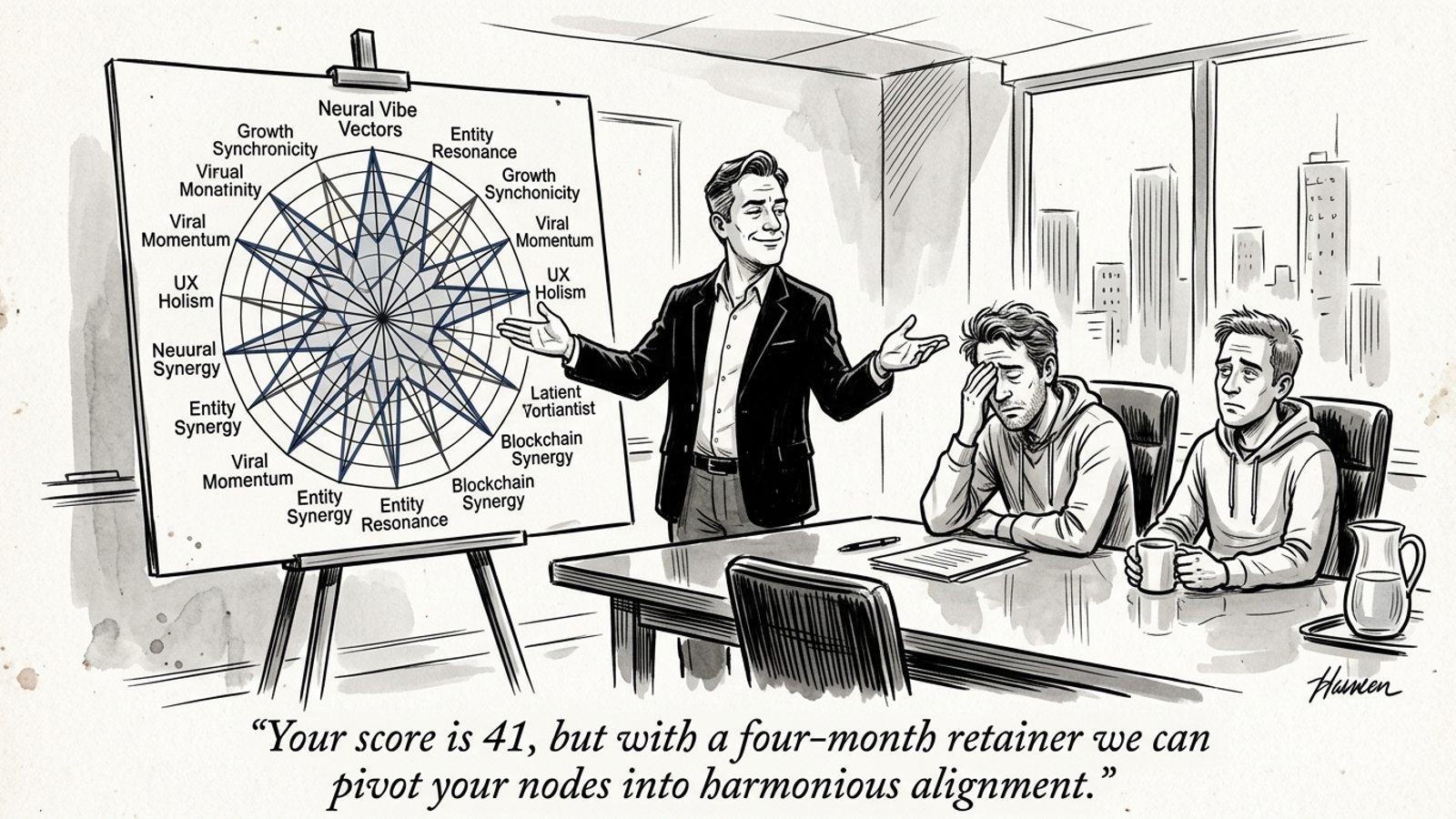
The chart also borrows authority from traditional rankings without showing how those rankings explain an AI citation. In Ahrefs’ study of 863,000 search queries and 4 million citations, only 37.9% of URLs cited in Google AI Overviews ranked in the top 10 organic positions; 31% of cited pages sat beyond position 100. A keyword map may tell you something useful about organic search. Calling it an entity resonance map does not show why an answer cites someone else. The missing link is an action, not another label for the same absence.
Your action: Make the gray dot larger. The slide does not assign anyone to do it.
Slide 19: 312 Content Gaps, Zero Pages Written
This is the deck’s busiest slide. The matrix lists 312 “generative topical voids” and recommends “authoritative informational pillars” for each variation of your category. The page count now feels like evidence of work.
The production method is less grand. The agency exports queries where your rivals rank and you do not, then places “AEO” in the column headers. Practitioners describe that pattern in community teardowns of AEO audits. The resulting sheet does not, by itself, show which queries receive AI answers, which answers cite sources, or which visitors might buy your product. It does supply 312 rows. Each row can be assigned a priority, which is not quite the same thing as deciding what deserves to be written.
There is another problem with treating every gap as an invitation to write a generic explainer. A Semrush and Kevin Indig study of 3,981 domain appearances across ChatGPT, Gemini, and Google AI Overviews found that 62% of citations were ghost citations: a domain appeared in a footnote link without the answer naming the brand. In that study, comparative, data-dense content produced 2.4 times more direct brand mentions than generic informational posts. The distinction matters if the deck promises brand visibility rather than a longer list of footnotes.
Naturally, writing the proposed pages is “out of scope.” The two-person marketing team may begin once it has chosen which of the 312 gaps to tackle, found product context for the copy, and cleared publication with everyone whose name appears in the review column. The spreadsheet does not make those decisions for them. It gives them a place to record how far behind they are.
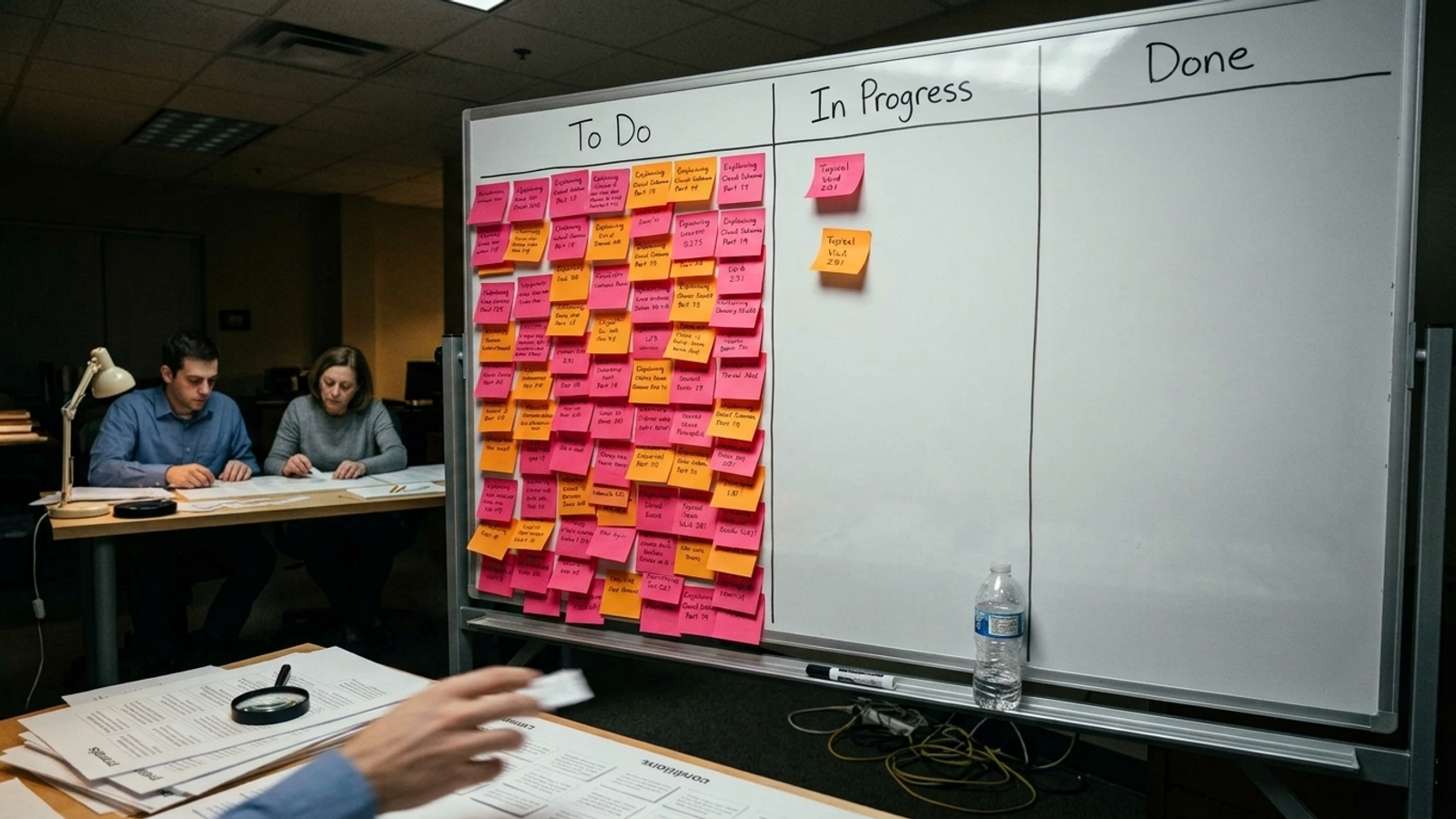
Your action: Produce the pages that make the gap report useful.
Slide 33: Technical Findings, Pending Developer Availability
The technical section arrives with red exclamation marks and recommendations for SpeakableSpecification, JSON-LD nesting, and @graph arrays. Please forward all 84 warnings to your engineer, along with no indication of which one should displace the current sprint.
One check deserves a place near the front: can the relevant crawlers fetch the pages at all? Practitioners troubleshooting crawler suppression at the CDN edge have found firewall rules serving 403 responses to bots. A clean robots.txt check will not tell you whether an edge rule blocks a request. The deck can devote fourteen pages to microdata while leaving that live response untested. Until someone checks it, the warning count says more about the deck than about access.
For readers who would rather check the response than admire the warning icons, there is a practical rundown of technical SEO issues that hurt AI visibility. The audit, meanwhile, has marked the technical work “Client Engineering Team.”
Your action: Find out which warnings affect access, then fix them.
Slide 48: An llms.txt File Becomes a Strategy
The centerpiece recommendation is an llms.txt file. I will call it a “foundational neural ingestion manifest that anchors your machine-readable semantic core.” It is a plain-text file of Markdown links. The elaborate phrase does not change the file.
More importantly, it does not establish that Google will use it. As Google’s position reported by Search Engine Land makes clear, llms.txt files do not help or harm Google Search rankings. A file may be simple to add; that is not a reason to sell it as the central route into Google’s AI answers. Ease of deployment is not evidence of impact. It is, however, convenient for a slide that needs a recommendation someone can complete without revisiting the rest of the audit.
Your action: Upload the file. Please do not mistake completion of this action for a visibility strategy.
Slide 94: Next Steps (For You)
The final slide contains a pastel RACI matrix titled Remediation Roadmap. At last, the proposal identifies an owner for every task:
| Task | Responsible party |
|---|---|
| Write the comparison pages | Client Marketing Team |
| Resolve crawler blocks and deploy technical changes | Client Engineering Team |
| Build outside mentions | Client PR Team |
| Review progress on a bi-weekly call | Agency |
Your company has a two-person marketing team, so the first row may require creative interpretation. The agency’s responsibility, “Strategic Governance and Progress Facilitation,” requires no such interpretation. We will ask whether you have finished. The matrix makes that division of labor easy to miss by giving each row the same amount of space.
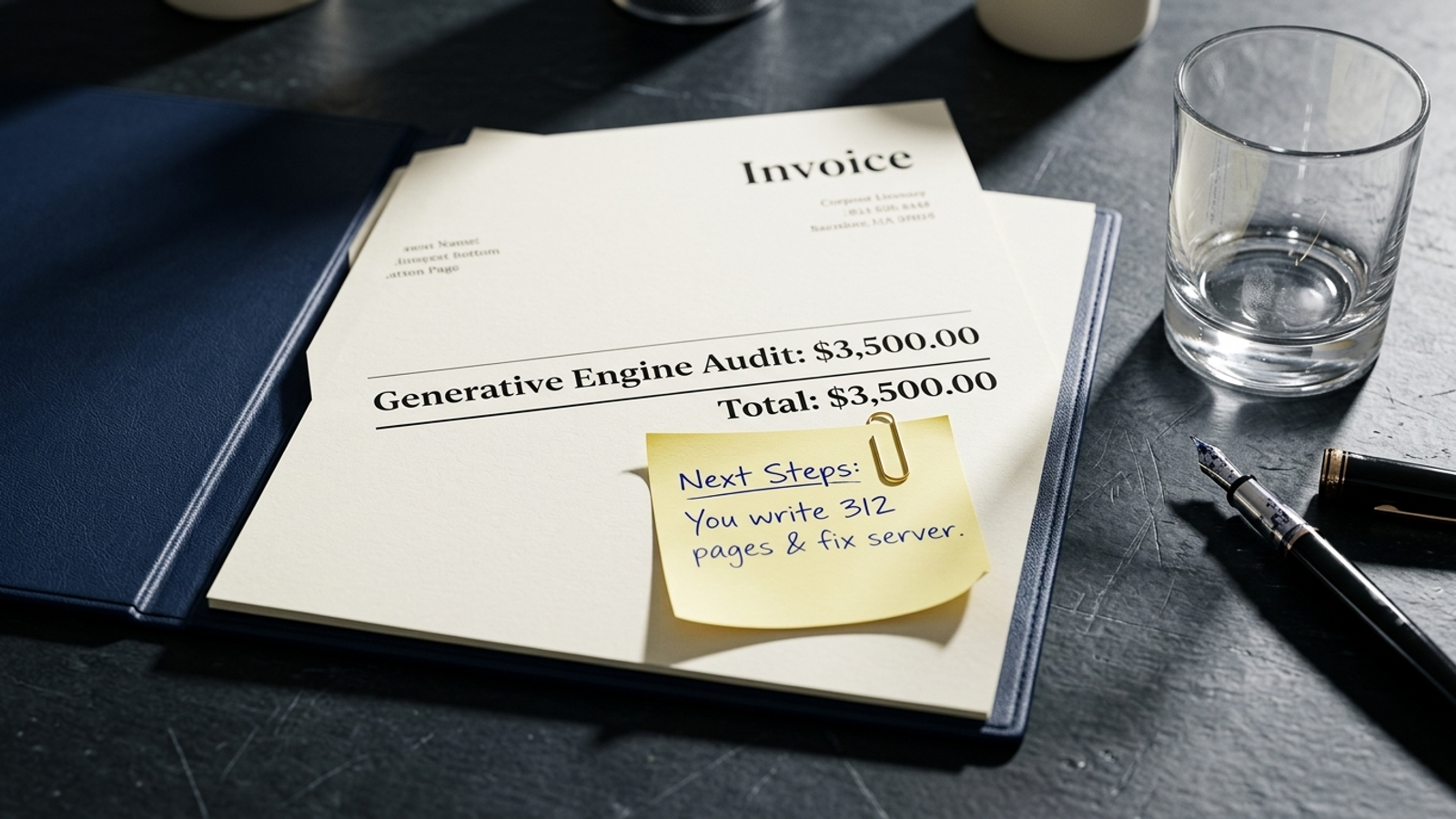
Your action: Supply the people, the hours, and the implementation that the audit fee did not buy.
Appendix A: Approved Translations for the Executive Team
Should anyone question the terminology before signing off, this table provides language suitable for an internal handover. Please retain the capital letters on the left; they took time to choose.
| What the deck says | What it means | Who does the work |
|---|---|---|
| Entity Resonance Deficit | Your brand is absent from relevant answers. | You |
| Topical Corpus Void | The report contains pages nobody has written. | You |
| Neural Ingestion Architecture | Upload an llms.txt file. | You |
| Edge-Layer Agent Friction | Check whether a firewall blocks crawlers. | You |
| Strategic Governance Retainer | Review your progress on a call. | Agency |
The translations are shorter because they omit the part where the deck pretends a label has completed a task. For a fuller comparison between reporting and doing, see whether an AEO tool gets you cited or merely tells you you are missing.
Appendix B: Client Execution Checklist
For teams proceeding without an additional implementation contract, I have condensed the work into the following checklist. The order begins with access, moves through material a model can use, and ends where most audits stop: publication. Completion should be recorded against live pages and responses, not against slides marked “reviewed.” A checked box on a proposal means only that someone approved the proposal.
- Check live crawler responses: Test HTTP responses for
GPTBot,ClaudeBot, andPerplexityBotat the CDN edge; a permissiverobots.txtfile does not rule out a 403. - Confirm server-rendered answers: Put critical text and tables in HTML available without client-side JavaScript hydration.
- Put the answer near the top: Place the core answer, benchmark, or pricing definition within the first 60 words under the relevant H2.
- Support claims with figures: Use verifiable numbers and named studies where they belong; the Aggarwal et al. research discussed here is the basis for this recommendation.
- Check entity consistency: Align your brand name, offerings, and business facts across relevant directories and review platforms.
- Deploy validated structured data: Put JSON-LD into live templates rather than leaving an unassigned engineering ticket.
- Record changes: Log published assets, server fixes, and citation movement instead of waiting for a quarterly review.
- Publish the high-intent comparison pages: A list of 312 opportunities earns nothing while the pages remain unwritten; the cost is leaving relevant answers to competitors who published theirs.
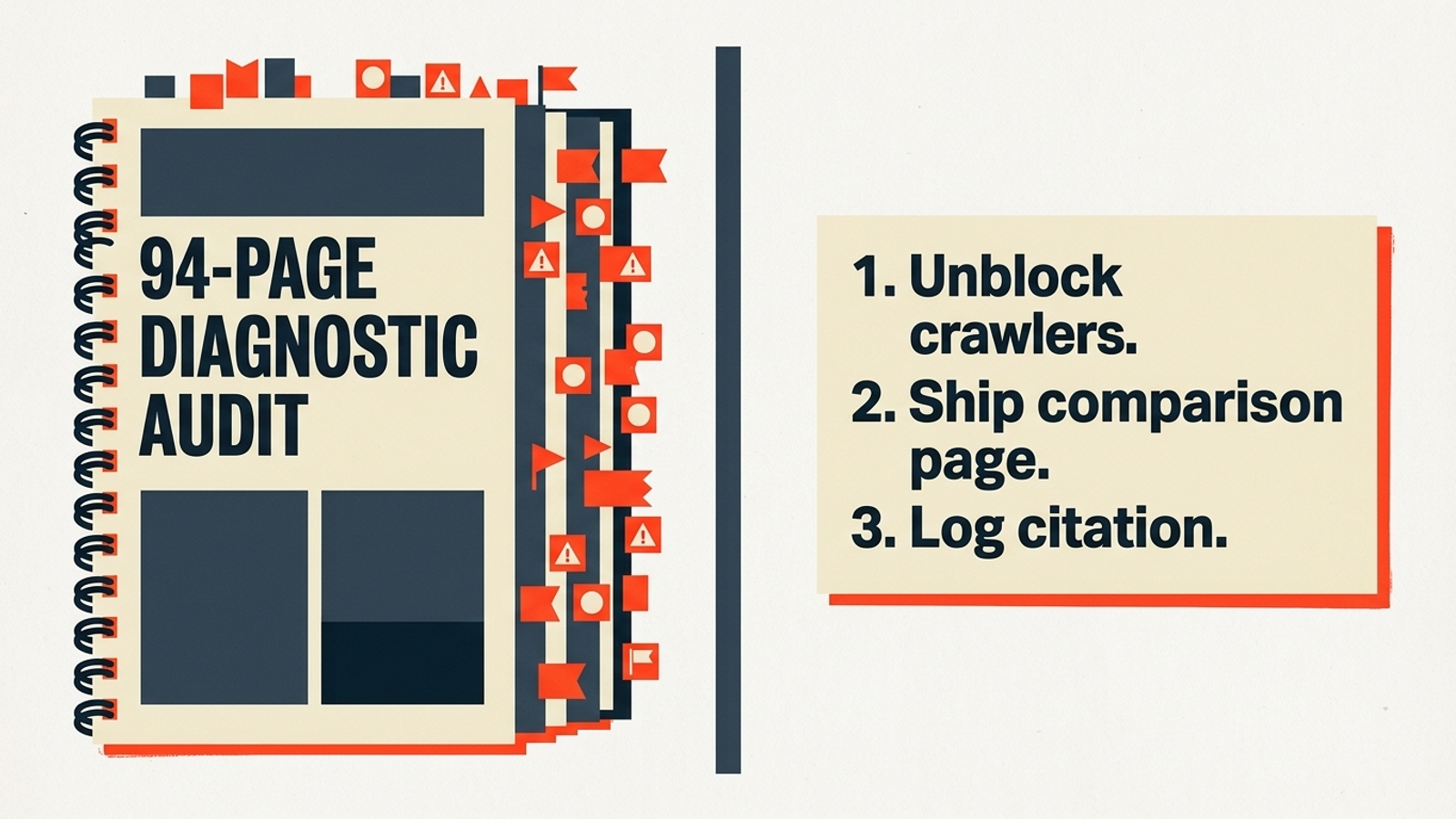
Slide 95, Available Under a Separate Agreement
This slide does not appear in the delivered PDF. It would contain the work: pages published, access problems resolved, and changes checked against what actually appears in search. That is harder to package as an audit because someone has to own the outcome after the call ends.
I understand the appeal of diagnosis. I managed accounts spreadsheet by spreadsheet; a good audit can tell you where to spend limited time. But a diagnosis priced and presented as the solution is a different product. When a report identifies 312 gaps and assigns all 312 to a team that could not write them before the report arrived, the bottleneck has not been removed. It has been color-coded.
The same distinction applies across search. Paid ad auctions keep moving; organic pages do not publish themselves because a consultant has described their absence. A quarterly deck can document both problems. It cannot execute the next change. That is the operating model groas is built to replace: specialized AI models handle continuous paid and organic search execution, while a named human strategist sets direction, guardrails, and accountability. The work is recorded in a live action log, with a flat monthly fee and month-to-month terms. The point is not to rename a report. It is to make execution the product.

Final Slide: Please Confirm Receipt
The 48-megabyte PDF is ready for distribution. Its radar charts are legible, its content gaps are numbered, and its final matrix identifies the person who must do the work. Before approving the next audit, skip to that matrix. If the execution column names your team on every consequential row, you already know what the proposal is selling.
An audit you have to execute yourself is a to-do list with a logo on it.